

Jain Online University MCA Project Available
Capstone Project & Project Report Work Assistance For JGI
We provide premium, high-quality Master of Computer Applications (MCA) Capstone Projects and Project Reports specifically designed for students at JAIN (Deemed-to-be University). Our services are focused on the advanced academic requirements of the MCA program, offering specialized support for your Capstone Project and Project Work Reports.
As per the official Jain Online University (JGI) guidelines, MCA students are required to submit a professional Synopsis, Interim Report, Final Project Report, and Video Presentation (Viva). We ensure your work follows the strictly defined academic structure, technical documentation, and coding standards required by JGI for a successful submission. These materials are created for learning and reference purposes, providing a clear roadmap for you to complete your own master-level research.

Synopsis Guidelines & Format for MCA at Jain Online University
The MCA Capstone Synopsis is the official technical proposal for your Final Year Capstone Project or Project Work at JAIN Online University. It serves as the strategic blueprint for your advanced software or system development and must be approved before you begin the development and implementation phase.
1. Title
-
Choose a clear, professional, and technical headline that directly represents the focus of your software development or advanced research study.
-
Example: "AI-Driven Predictive Analytics for Financial Risk Management" or "Secure Healthcare Data Management using Blockchain Technology."
2. Problem Statement (200 words)
-
Analyze the existing technical gaps, manual inefficiencies, or software limitations you aim to solve.
-
Describe the complex technical challenges or data processing hurdles currently faced by users.
-
Justify why an advanced digital solution is required for modern enterprise or research needs.
-
Highlight the specific technological context (e.g., Cloud, AI, Cyber Security) relevant to your MCA specialization.
3. Objectives of the Research (2 or more)
-
Define the core high-level functionalities the system will perform upon completion.
-
List specific technical features, such as algorithm implementation, API integrations, or data modeling.
-
Explain the value the project provides to the organization, end-users, or the field of computer science.
-
Ensure all objectives are SMART (Specific, Measurable, Achievable, Relevant, and Time-bound within the 8-week period).
4. Research Methodology (500 words)
-
Identify the Software Development Life Cycle (SDLC) model (e.g., Agile, Scrum, or Waterfall) used for development.
-
Specify your Tech Stack: Define programming languages (Python, Java, etc.), Frameworks, & Database management systems.
-
Outline the methodology for requirement gathering, system architecture design, and data flow.
-
Describe the advanced tools and frameworks used for system testing, performance optimization, and debugging.
5. Limitations (200 words)
-
Clearly state specific high-level features or modules that are outside the scope of this version.
-
Address constraints such as the strict 8-week project timeline.
-
List technical dependencies, such as specific cloud environments, hardware requirements, or OS compatibility.
-
Clarify any limitations regarding data access or third-party API restrictions.
6. Work Plan (8 Weeks)
-
Week 1-2: Topic Finalization, Literature Review, and Requirement Analysis.
-
Week 3-4: System Design (UML, ER Diagrams) and Database Architecture.
-
Week 5-6: Coding, Module Development, and Integration.
-
Week 7: System Testing, Bug Fixing, and Quality Assurance.
-
Week 8: Final Documentation, Thesis Drafting, and Presentation Prep.

A professional cover page layout for an MCA Semester IV project synopsis following latest JGI university branding and documentation standards.

Detailed introduction documentation for a Master of Computer Applications project report at Jain Online University.

A detailed 8-week timeline and activity table required for successful Jain Online University MCA project submission.
A professional cover page layout for an MCA Semester IV project synopsis following latest JGI university branding and documentation standards.
Interim Report Guidelines for MCA at Jain Online University
The Interim Report tracks the mid-stage progress of your MCA Capstone Project or Project Work. It documents your current achievements in advanced development and the technical milestones reached during the implementation phase.
1. Objectives of the Study (2 or more)
-
Use the exact high-level objectives that were officially approved in your MCA Synopsis.
-
Ensure the points maintain strict consistency with your original postgraduate proposal.
-
List the core technical functions and complex features as per your initial architecture.
-
Confirm that these research and development goals are being strictly followed.
2. Scope of the Study
-
Define the technical boundaries, advanced algorithms, and specific modules of the application.
-
Specify the target enterprise platform (Cloud, Web, Mobile) and the project timeline.
-
List the integrated modules and clearly state any high-level functions excluded from the current version.
-
Clarify the organizational environment or technical ecosystem where the system is deployed.
3. Research Methodology
-
Describe the advanced technical approach and the SDLC model (e.g., Agile, DevOps, or Spiral) in use.
-
Detail the step-by-step process of system construction, module integration, and performance testing.
-
Categorize the project as either a development-based solution or an analytical research study.
-
Outline the transition from complex requirement analysis to actual backend and frontend coding.
4. Research Design
-
Present the technical blueprint for the system architecture, including UML diagrams and database schemas.
-
Show how the design patterns (e.g., MVC, Microservices) ensure all functional requirements are met.
-
Detail the data flow (DFD) and the hierarchical structure of the software components.
5. Data Collection Method
-
Detail the methods used to gather enterprise-level software and stakeholder requirements.
-
Include primary sources such as technical interviews, user experience (UX) surveys, or client feedback.
-
List secondary sources such as academic journals, GitHub repositories, and official technical documentation.
6. Sampling Method
-
Explain the selection process for the datasets or user groups used for system stress-testing.
-
Specify the type of synthetic or real-world datasets utilized for training models or testing databases.
-
Define the logic for prioritizing specific core modules during the initial development cycles.
7. Data Analysis Tools
-
List the professional tech stack used, such as VS Code, IntelliJ, Python, Java, or MongoDB.
-
Explain how these frameworks and IDEs facilitate building, debugging, and verifying the system.
-
Use charts or tables to visualize the current progress of each module (e.g., a Gantt chart or Burndown chart).
-
Mention advanced testing tools (like Selenium, JUnit, or Postman) used to identify and resolve technical bugs.

The official interim report cover page layout for a JGI MCA Semester IV project, featuring university branding and student detail placeholders.

This page outlines the specific objectives of the study and defines the research scope regarding consumer behavior analysis.

Final page covering the use of mean, median, mode, and comparative analysis to interpret research trends and behavioral patterns.
The official interim report cover page layout for a JGI MCA Semester IV project, featuring university branding and student detail placeholders.
Final Project Report Guidelines for MCA at Jain Online University
The Final Project Report is a comprehensive academic document that presents the final outcome of the MCA Capstone Project or Project Work at JAIN Online University. It synthesizes all key sections of the postgraduate technical study, including advanced system architecture, implementation screenshots, performance analysis, findings, and future scope into one professionally structured submission.
Title Page
-
Include the project title, student name, USN, semester, and submission date. Mention: "Submitted in partial fulfillment of the requirements for the award of Master of Computer Applications.
Declaration
-
A formal statement confirming the originality of your code and documentation.
Certificate
-
The official document signed by your project guide confirming the work was carried out under their professional supervision.
Acknowledgement
-
Professional thanks to the university, faculty, organization, and those who supported the research.
Table of Contents
-
A detailed list of all chapters, sub-headings, tables, and figures with corresponding page numbers.
Executive Summary
-
Provide a 1-page high-level overview of the project’s purpose and technical results. Summarize the advanced tech stack used, the specific complex problem solved, and the final impact of the solution.
Chapter 1 – Introduction and Background
-
Define the core purpose of the software and the high-level problem it addresses.
-
Provide an overview of the technical domain (e.g., Machine Learning, Cloud Security) and the organization involved.
-
Include an in-depth analysis of the industry trends related to your project.
Chapter 2 – Review of Literature
-
Summarize existing high-level software systems, frameworks, or academic research related to your topic.
-
Critically highlight the technical or functional gaps that your Master-level project intends to fill.
Chapter 3: Project Planning and Methodology
-
Reiterate the advanced objectives and scope defined in your approved synopsis.
-
Describe the SDLC model (Agile, Scrum, DevOps, etc.) utilized for project management.
-
List the complete Technical Stack: Programming languages, backend databases, APIs, and development environments (IDEs).
Chapter 4: Data Analysis, Design and Implementation
-
System Design: Present the architecture using UML Diagrams (Class, Sequence, Use Case), ER Diagrams, and Data Flow Diagrams (DFDs).
-
Implementation: Showcase the core logic, algorithm flow, and high-resolution screenshots of the user interface and backend modules.
-
Data Interpretation: Provide technical analysis and descriptions below every table, graph, or architectural diagram.
Chapter 5: Results, Findings, Recommendations, Future Scope & Conclusion
-
Results: List technical findings and system test results (Unit, Integration, and UAT) in clear bullet points.
-
Future Scope: Suggest advanced features for future iterations, such as AI integration or cross-platform scalability.
-
Conclusion: A final summary confirming the project’s success, utility, and its contribution to the field of Computer Applications.
Bibliography / References
-
Bibliography / References: List all sources (Books, Journals, Research Papers) following APA referencing format.
-
Appendices: Include supplementary materials like code snippets of core algorithms, API documentation links, user manuals, or large data tables.
Appendices (if any)
-
List all websites, technical manuals, and books used in APA format.
-
Include links to API documentation or libraries used during coding.

This page serves as the initial identification sheet for the project, containing the student's name, USN, elective name, and the date of submission

The official title page which includes the project topic name, degree fulfillment statement, student USN, and the name of the project guide.

A complete list of academic citations, web references, and journals used to support the Jain Online University MCA final project report.
This page serves as the initial identification sheet for the project, containing the student's name, USN, elective name, and the date of submission
Video Presentation Guidelines for MCA at Jain Online University
The Video Presentation is a critical component of the MCA Capstone Project or Project Work at JAIN Online University. It is a structured 5-minute presentation designed to demonstrate your expertise in advanced computing. The purpose is to showcase your project’s strategic objectives, technical architecture, implementation outcomes, and the high-level professional skills you have mastered.
Introduction
-
State your full name, USN, and confirm your enrollment in the MCA program.
-
Clearly announce your Capstone Project title and the core technologies utilized.
-
Maintain a brief, professional, and authoritative tone to establish your technical expertise.
Project Objectives
-
Reiterate the advanced objectives defined in your approved MCA Synopsis.
-
Explain the complex technical problem or research gap your project addresses.
-
Highlight the strategic value your application provides to the enterprise or the field of Computer Applications.
Research Methodology
-
Specify the SDLC or Project Management model used (e.g., Agile, DevOps, or Scrum).
-
Detail your Advanced Tech Stack: List programming languages, cloud services, databases, and specialized frameworks.
-
Describe the process of requirement engineering and system architecture design.
-
Mention the professional tools used for development, version control (e.g., Git), and rigorous testing.
Project Outcome (Findings, Conclusion, and Recommendations)
-
Showcase the core high-level features and the final functional results of your system.
-
Summarize the findings from your performance testing, security audits, or user acceptance testing (UAT).
-
Provide a definitive conclusion on the project’s success in meeting postgraduate research goals.
-
Offer technical recommendations for future scalability, such as microservices transition or AI enhancements.
Learning Aspects
-
Reflect on the advanced technical skills developed, such as full-stack integration, data modeling, or algorithm optimization.
-
Mention mastery of industry-standard tools, libraries, or architectural patterns.
-
Highlight how this Capstone project has prepared you for senior-level roles in the IT industry.
Closing
-
Express professional gratitude to the university faculty and your project guide for their academic mentorship.
-
Acknowledge the contribution of the internship organization or research body, if applicable.
-
Conclude with a formal and confident closing statement.
Video Sample for MCA at Jain Online University Students

This slide introduces the student's name, USN, and project title, establishing technical expertise for the Jain Online University MCA final presentation.
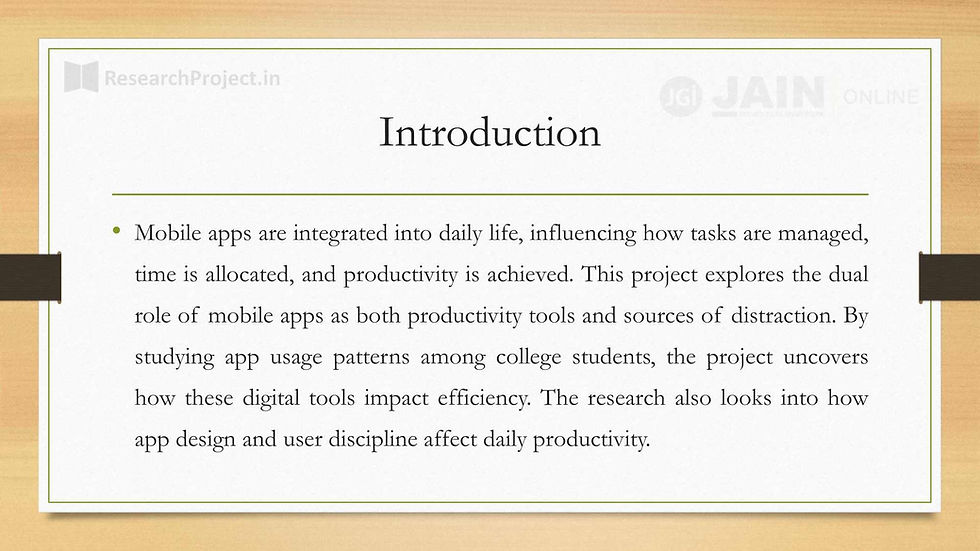
This slide introduces Introduction and background of this project.

The final concluding slide for the Jain Online University MCA video presentation, featuring professional gratitude toward faculty, project guides, and a confident closing statement.
This slide introduces the student's name, USN, and project title, establishing technical expertise for the Jain Online University MCA final presentation.