
.jpg)
Jain Online University MA Project Available
Research Project Assistance For Jain University
We provide premium, high-quality Master of Arts (MA) Project Reports specifically designed for students at JAIN (Deemed-to-be University). Our services support the complete range of MA academic requirements, including Research Project for final-year, ensuring subject relevance across Arts and Humanities disciplines.
As per the official Jain Online University (JGI) guidelines, MA students are required to submit a well-structured project proposal/synopsis, progress or interim submission (where applicable), and a final project or dissertation report, sometimes accompanied by a presentation file. We ensure that every project strictly follows the prescribed academic format and university standards. All materials are prepared solely for learning and reference purposes, enabling students to understand the methodology and confidently develop their own original academic submissions.

Synopsis Guidelines and Format for MA at Jain Online University
The MA Synopsis is the official research proposal for your Master of Arts (MA) Research Project at JAIN (Deemed-to-be University). It serves as a structured blueprint of your research plan and must receive approval before you proceed with the final project report.
1. Project Title
-
Choose a clear, precise, and academically relevant title that reflects the core theme of your MA research. The title should align with your chosen discipline such as Jainology, Comparative Religion and Philosophy, English, Economics & Public Policy, and clearly indicate the scope of the study.
2. Problem Statement (Approx. 200 Words)
-
Identify the Research Gap: Clearly define the social, economic, cultural, literary, or psychological issue your study aims to address.
-
Background: Provide brief theoretical or contextual background related to the topic.
-
Significance: Explain the academic and societal importance of studying this issue in the contemporary context.
3. Research Objectives
-
State two or more well-defined research objectives.
-
Explain how your study contributes to knowledge within your Arts discipline.
-
Objectives should be clear, focused, and achievable within the given timeframe.
4. Research Methodology (Approx. 500 Words)
-
Type of Research: Specify whether the study is Descriptive, Exploratory, Analytical, or Empirical.
-
Primary Data: Surveys, interviews, observations (if applicable).
-
Secondary Data: Books, journals, research papers, reports, government publications, and online academic databases.
-
Tools & Techniques: Mention qualitative or quantitative tools such as content analysis, thematic analysis, simple statistical methods, charts, or tables, as applicable to the subject.
5. Limitations (Approx. 200 Words)
-
Short duration of the project (generally 8 weeks)
-
Limited sample size or availability of respondents (if primary data is used)
-
Restricted geographical or thematic scope
-
Dependence on secondary data sources (if applicable)
6. Week Work Plan of 8 Weeks
-
Prepare a detailed week-by-week activity schedule, outlining tasks such as topic selection, literature review, data collection, analysis, report writing, and final submission to ensure systematic and timely completion of the project.

This page serves as the official cover sheet for an MA research proposal. It features the university branding and a structured table to record the student’s identity, identification number, and specific elective subject. It also includes a designated field for the submission date to ensure proper academic logging

This section presents the formal research title and a detailed problem statement regarding the impact of modern habits on behavioral patterns. The text examines how specific platforms influence communication and emotional well-being, highlighting a balance between positive benefits and potential psychological risks. It emphasizes the need for research to promote digital awareness and responsible usage.

The final section addresses research limitations such as a restricted time frame and sample size constraints. It concludes with a comprehensive 8-week work plan in a tabular format. This schedule tracks the project’s progress from the initial topic selection and synopsis submission to the final proofreading and university delivery.
This page serves as the official cover sheet for an MA research proposal. It features the university branding and a structured table to record the student’s identity, identification number, and specific elective subject. It also includes a designated field for the submission date to ensure proper academic logging
Interim Report Guidelines for MA at Jain Online University
The MA Interim Report is a mid-project progress document that reviews the status of your Master of Arts (MA) Research Project and ensures that the research is progressing systematically in accordance with the approved synopsis.
1. Objectives of the Study
-
State two or more clear and focused research objectives.
-
Explain the academic and social relevance of the study within your chosen Arts discipline.
-
The final objective should emphasize the practical, theoretical, or societal contribution of your research.
2. Scope of the Study
-
Clearly define the subject area, thematic focus, geographical context (if applicable), and time period of the study.
-
Specify what aspects the research covers and what elements are excluded, ensuring clarity of boundaries.
3. Research Methodology
-
Describe the overall research approach adopted in the study.
-
Specify the type of research (Descriptive / Exploratory / Analytical / Empirical).
-
Explain the logical sequence followed from problem identification to data interpretation.
4. Research Design
-
Present the systematic plan or framework used to achieve the stated research objectives.
-
Explain how the chosen research design ensures academic rigor, reliability, and validity.
5. Data Collection Method
-
Primary Sources (if applicable): Interviews, surveys, questionnaires, observations, case studies.
-
Secondary Sources: Textbooks, academic journals, research articles, government publications, reports, and credible online databases.
6. Sampling Method
-
Define how the sample or respondents were selected from the population.
-
Mention the sampling technique used (Random / Stratified / Purposive / Convenience sampling), where relevant.
7. Data Analysis Tools
-
Tools such as Microsoft Excel, basic statistical techniques, or qualitative analysis methods.
-
Use of percentage analysis, trend analysis, thematic analysis, and
-
Representation of findings through tables, charts, and graphs for clarity.

This page serves as the standardized cover sheet for an MA Interim Report at Jain Online (Deemed-to-be University). It includes administrative fields for the student's name, USN, specific MA elective, and the date of submission to ensure proper tracking of academic progress.

This section outlines the specific goals of the research, such as examining usage patterns and analyzing behavioral impacts. It also defines the scope of the study, clarifying the behavioral and social aspects covered while explicitly stating exclusions like clinical psychological analysis to maintain focus within the project's limits.

This page summarizes the methods used to gather data, combining primary questionnaires with secondary academic sources. It specifies the use of convenience sampling for the study population and identifies simple statistical tools like percentage analysis and graphical representations—such as bar and pie charts—for presenting research findings clearly.
This page serves as the standardized cover sheet for an MA Interim Report at Jain Online (Deemed-to-be University). It includes administrative fields for the student's name, USN, specific MA elective, and the date of submission to ensure proper tracking of academic progress.
Final Project Report Guidelines for MA at Jain Online University
The Final Project Report is a comprehensive academic document that presents the outcomes of the Master of Arts (MA) Research Project at JAIN (Deemed-to-be University). It integrates all major components of the research work, including the introduction and background, review of literature, research methodology, analysis and interpretation, findings, conclusions, references, and appendices into one structured and formally submitted document.
Title Page
-
Project title
-
Student name
-
USN
-
Program and specialization (MA – subject)
-
Semester
-
Date of submission
Declaration
-
A declaration by the student confirming the originality of the work.
-
Statement that the project has not been submitted to any other university or institution.
-
Student’s name, USN, place, and date.
Certificate
-
Certification from the project guide / faculty supervisor confirming that the research work has been carried out under their guidance.
-
Include guide’s name, designation, university name, and date.
Acknowledgement
-
A brief note expressing gratitude to Jain Online University, faculty guide, family members, and peers.
-
Written concisely in the student’s own words.
Executive Summary
-
A concise overview of the complete project (approximately 1–2 pages).
-
Should summarize the purpose of the study, methodology adopted, key findings, and conclusions.
Table of Contents
-
List of chapters and sub-sections with page numbers.
-
Include separate lists for tables, figures, and graphs, if applicable.
Chapter 1 – Introduction and Background
-
Introduction to the research topic
-
Purpose and significance of the study
-
Background and contextual overview
-
Explanation of key theoretical or conceptual frameworks
-
Social, cultural, economic, political, or historical context relevant to the study (subject-specific)
Chapter 2 – Review of Literature
-
Review of relevant books, journals, research articles, and previous studies related to the topic.
-
Identification of research gaps highlighting areas not adequately explored in existing literature.
Chapter 3 – Research Methodology
-
Objectives of the Study
-
Scope of the Study
-
Research Approach and Methodology
-
Type of Research (Descriptive / Exploratory / Analytical / Empirical)
-
Research Design (framework or plan of study)
-
Data Sources (Primary and/or Secondary)
-
Sampling Method (if applicable)
-
Tools and Techniques for Data Analysis
-
Period of Study
-
Limitations of the Study
-
Academic or Social Relevance of the Research
Chapter 4 – Data Analysis and Interpretation
-
Presentation of collected data using tables, charts, graphs, or thematic frameworks.
-
Each table or figure must be properly numbered and titled.
-
Analytical interpretation should be written below each table or figure.
-
Maintain clarity and consistency; preferably use one page per table/figure set.
Chapter 5 – Findings, Recommendations, and Conclusion
-
Present key findings in clear, concise, and evidence-based points.
-
Provide suggestions or implications for academics, policymakers, or society, depending on the discipline.
-
Include a brief section on scope for future research.
-
Conclude the chapter with a logical and well-articulated conclusion summarizing the overall study.
Bibliography / References
-
List all sources cited in the report using APA referencing style.
-
Include books, journal articles, research papers, reports, and credible online sources.
Appendices (if any)
-
Supplementary material that supports the research but is too detailed for the main chapters.
-
Examples include questionnaires, interview schedules, extended tables, raw data, or calculations.

This is the mandatory first page for any Master of Arts final project submission at Jain Online University. It provides a professional layout for the university’s branding and includes specific placeholders for the project title, the student’s full name, the University Seat Number (USN), the elective subject, and the final date of submission.

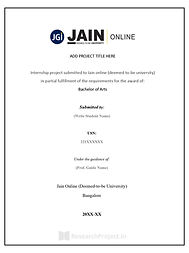
This secondary cover page serves as the formal academic title sheet. It specifies that the report is submitted in partial fulfillment of the requirements for the Master of Arts degree. It includes dedicated sections for the project title, student name, USN, and the official name of the academic guide or supervisor overseeing the research.

This final document is the Plagiarism Certificate, which provides official verification that the Master of Arts project report is original and free from academic dishonesty. It typically displays the similarity index percentage from authorized software, certifying that the content meets the university's strict guidelines on plagiarism. This certificate is a mandatory requirement for final submission at Jain Online University, serving as a testament to the student's commitment to academic integri
This is the mandatory first page for any Master of Arts final project submission at Jain Online University. It provides a professional layout for the university’s branding and includes specific placeholders for the project title, the student’s full name, the University Seat Number (USN), the elective subject, and the final date of submission.
Video Presentation Guidelines for MA at Jain Online University
The Video Presentation is a mandatory component of the Master of Arts (MA) Research Project at Jain Online University. It is a 5-minute structured presentation that concisely summarizes your research work. The objective of this presentation is to demonstrate your understanding of the research objectives, methodology, analysis, findings, conclusions, suggestions, and personal learning outcomes gained during the project.
Slide 1- Professional Introduction
-
State your full name, USN, MA program (with specialization), and project title clearly and professionally.
Slide 2- Project Objectives
-
Explain the purpose of the study.
-
Justify the selection of the research topic and highlight its academic, social, cultural, or policy relevance, depending on your Arts discipline.
Slide 3- Research Methodology
-
Mention the type of research adopted (Descriptive / Exploratory / Analytical / Empirical).
-
Specify the data sources used (Primary and/or Secondary).
-
Briefly describe the tools or techniques applied for data analysis and interpretation.
Slide 4- Project Outcome (Findings, Conclusion, and Recommendations)
-
Summarize the key findings of the study.
-
Present the conclusion drawn from the research.
-
Highlight suggestions or implications relevant to academics, society, or policymakers.
Slide 5- Learning Aspects
-
Discuss the knowledge, research skills, analytical abilities, and subject understanding gained during the project.
-
Explain how the project contributed to your academic development and future career prospects.
Slide 6- Closing
-
Express gratitude to Jain Online University, your project guide, and all individuals who supported your research.
-
Conclude the video with a formal and professional closing statement.
Video Sample for MA at Jain Online University Students

This slide serves as the formal opening for a Master of Arts VIVA presentation at Jain Online (Deemed-to-be University). It establishes the professional context of the research, providing clearly defined areas for the project's title, the student's identification details, and the name of the assigned academic guide.

This section serves as the foundational introduction for the academic project. It outlines the general importance of the subject matter within the Master of Arts curriculum and explains how the study provides insight into current behavioral or social patterns. The slide establishes the context of the research, highlighting its relevance in a modern setting and defining the project as a systematic investigation into the chosen topic.

This final slide marks the conclusion of the VIVA presentation. It is used to formally thank the faculty and examiners for their time and attention during the project defense.
This slide serves as the formal opening for a Master of Arts VIVA presentation at Jain Online (Deemed-to-be University). It establishes the professional context of the research, providing clearly defined areas for the project's title, the student's identification details, and the name of the assigned academic guide.